

The term API software stands for Application Programming Interface. It uses predefined procedures to create and integrate software applications, enabling communication between them throughout the process.
Therefore, we can talk about APIs based on specific instructions that design software modules to communicate or interact with other modules in one or more functions. It all depends on the application being used and the permissions the API owner grants to another developer.
For the average user, all they can see in the API is how to open an event, a mobile game, how to log in and connect to a Facebook account, or how game results are announced on Twitter. Or when the app sends an alert to their mobile phone or computer.
As we mentioned earlier, APIs can have single or multiple functions, and they can be very powerful tools. When this happens, the application can send a request with a specific pattern, which determines how the program or software sends the response to the request.
It can be personal for business use, open only to partners, or open to any developer to interact with or create their own APIs. It can also be a local API for applications communicating within the environment or on a device, or a remote API when accessing different content.
It also allows other users to use parts of the application or service without giving up all the features of the unopened service. These third-party developers can use these features without needing to know how the process works internally.
What are APIs used for?

One of the main features of software APIs is that they simplify the developer’s work and save time and money. For example, if you’re creating an online store application, you don’t need to build a payment or other system from scratch to check product availability. You can use the API of an existing payment service like PayPal and request an API to tell the sender what’s in stock.
It is also useful if you want to deliberately use the features of a particular service to benefit users or persuade users of that service to use your application.
Another classic example is a third-party application linked to a service. For example, social networks like Twitter or Reddit allow you to create and link to non-governmental applications. This application requires the social network’s API to present the information and internal processes that make it function.
In these cases, APIs can restrict the functionality available to third-party applications for services or relationships. For example, Twitter has been repeatedly reported to interfere with developers by restricting which users can use its API.
Sometimes, other services deliberately create APIs that third parties can use for certain tasks, thus developing new features to extend their applications and preferences. Examples of such APIs include Google, which developed Google Docs to enable the automatic creation of mailing lists or the sale of other services.
Benefits of APIs

APIs have many advantages, as they allow you to leverage the capabilities of other software or take advantage of the infrastructure of another platform.
So you can reuse numbers that have proven their effectiveness perfectly. Linguistic and technological freedom: You can customize your time or hone your skills in any language or technology that suits your project’s needs or ideas.
It doesn’t matter if the technology used by the API changes in the future. You just need to respect the API’s functions and do what’s necessary. Regarding user experience, although it depends on how the user interacts with it, in theory, API-based website development generally performs better than an existing website.
From the moment you request it from the server, you get a plain text file that takes less time to send if you combine it with HTML/CSS. In this web application, it’s not necessary to load the page, and it’s not a special application, but it’s very important.
Server/client separation
Because they are independent, they communicate via JSON exchange. The client is unaware of what the software API has created, and the server is unaware of what you do with the data you provide. Refactoring or evolution can be performed on both the front and back ends.
Scalability, reliability and flexibility
If the connection between the client and the server is good, then everything is fine. You can change the server or the database, and it won’t fail to return the data you need. Because it uses the API, it can scale as needed.
You can meet the requirement and create multiple web interfaces or applications for any device. Since you can forward pages through the server and the API is hosted on a separate server, you have an easier way to run your application.
Minimum capacity required.
It requires no memory, can handle multiple requests, and requires no HTML writing, thus reducing the server’s performance cost.
Guide for API development
Platzi has a great article written by one of its users that explains a bit about software API development, so we’re going to give you a short guide on how to do it.
When you write numbers, you’re used to recording them with instructions that describe their function. For example, a function that returns an item containing all users is called get_users or getUsers.
It’s good in code. However, this also happens with URLs, and it’s not good practice. Suppose you create an API with a URL that returns JSON with all the available classes. So the first thing that comes to mind is to create a URL like this:

Similarly, if you need multiple URLs to create, modify, delete classes, or obtain information about a particular class, the URL is:

As time goes on and you create more and more URLs, it will start to become boring and hard to remember. A better solution would be to maintain two base URLs per resource. This will make your URL look like this:

The focus here is on titles that describe each resource without using descriptive words. You can now use HTTP verbs as fields in uppercase. CRUD (Create – Read – Edit – Delete) can display the verbs POST, GET, PATCH (formerly PUT), and DELETE. Continuing, with just one example of a class and two base URLs, you can do the same thing in a more understandable way. It works like this:
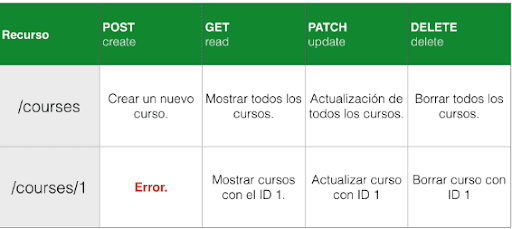
Let’s keep it simple and easy. When choosing a name for a property, consider using a rock name that refers to the place you just read about, rather than a more general name. Now I think we need to post Platzi’s comments, videos, and tweets.
Given the above, it’s not a good idea to write URLs like /product or /content. In fact, it’s a very abstract name and doesn’t indicate what type of resource is being used. On the other hand, if you create URLs like /ads, /videos, /tweets, the developer will immediately know what each URL is.
Choosing a name to identify resources is usually easy. My final recommendation is to do a lot of it. Like many other APIs, don’t compare words and batches. In short, let’s keep the URL simple and unique.
Relationship between resources
For now, this arrangement may seem simple. But what if the resources are linked together? Suppose you want to write a URL that retrieves the username of every student who has taken special education. It would look like this:

How can I get a JSON file with all the students who have completed a course but also received a Christmas subscription? The URL can be much longer.

As you can see, this URL does not follow API understanding best practices. In the previous case, and generally for resource relationships, you can define simple rules that are effective during creation. The URL should have a maximum of two levels, meaning the resource identifier. However, we should avoid value URLs.

This problem can be solved in a smarter and cleaner way. Use the parameter with “?”

Or apply more restrictions and eliminate these agencies:

Applying URL restrictions also allows you to apply filters to your queries and save the URL as easily as possible.
Let’s learn to handle mistakes!
When a developer works with an API, everything that happens inside it is a black box to them. If something goes wrong and they don’t receive enough data, using the API will start to tire and burn them out. Let’s consider how this process works when learning the trade or using new tools.
Designers often learn by doing and through trial and error. Therefore, API bugs will be one of our users’ most valuable tools. Just as you use HTTP verbs to execute (CRUD) operations on resources, you can also write HTTP code to indicate the status of a request.
On the other hand, if your API is large and complex, we recommend managing error numbers. Generally, the response falls into three categories:
- Everything worked perfectly.
- An error occurred because the request was invalid.
- An error occurred on all three sides.
We can manage any policy however we want. However, it’s recommended not to exceed this number. For example, Google’s GData API only uses 10 digits. Netflix’s API only uses 9. You can decide based on the complexity of your system. But be sure to keep it simple. When dealing with incorrect numbers, remember that you’re communicating with people and using words that others can understand.